
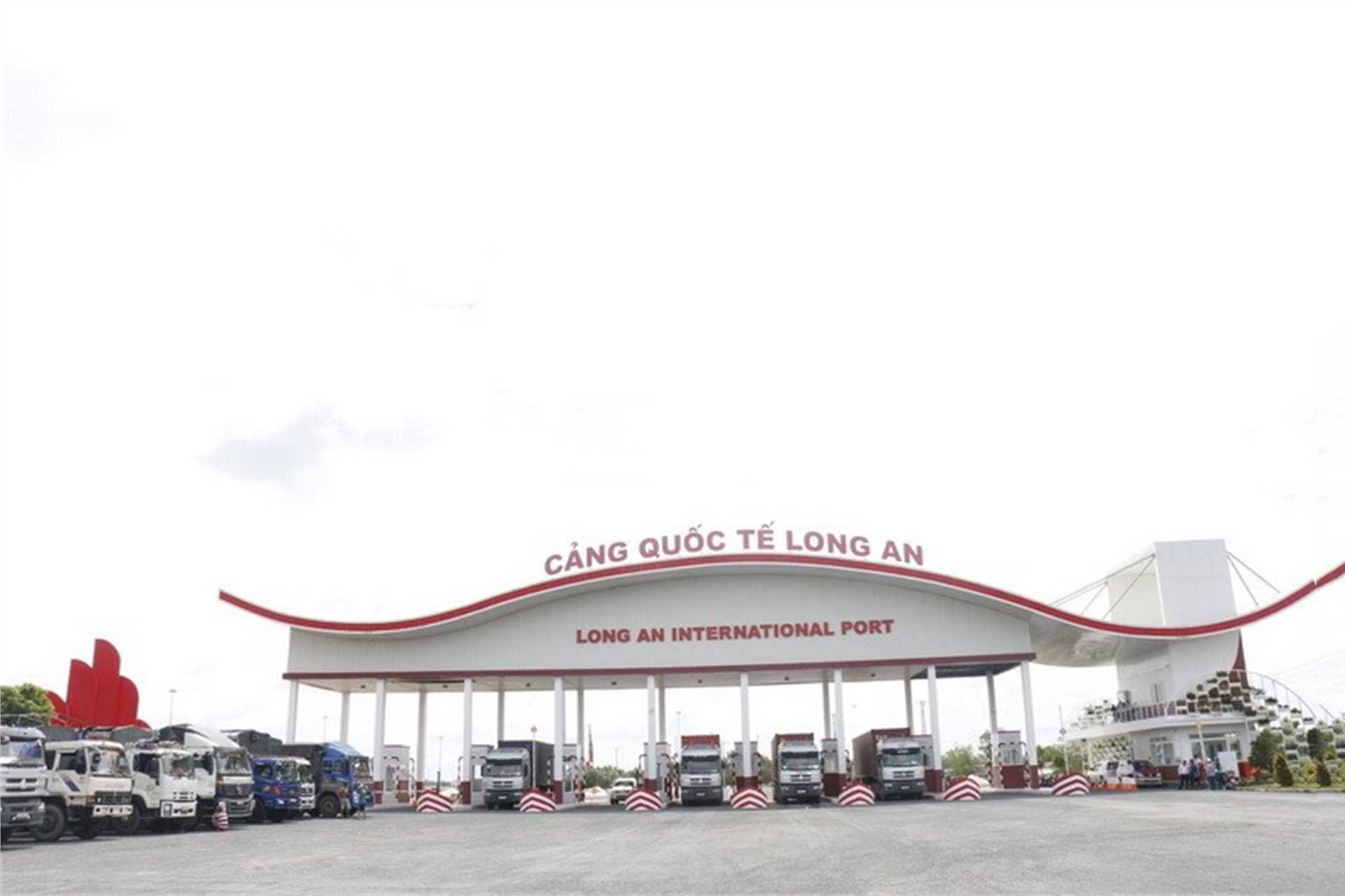
SOUTHEAST ASIA INDUSTRIAL PARK
Province
Long An
Occupancy Rate
Updating
Area
560 hectares
Lease Price
60 USD/m2
The Southeast Asia Industrial Park (also known as the Bac Tan Tap Industrial Park) is a crucial component in the overall master plan of the Long An International Port Project, covering an area of 1,935 hectares. This project is invested in and directly operated by Long An Industrial Park Joint Stock Company – a member of Dong Tam Group (DTG). It includes the following main subdivisions:
- Long An International Port: 147 hectares
- Southeast Asia Industrial Park: 396 hectares
- Southeast Asia Industrial Service Zone: 239 hectares
- Southeast Asia New Urban Area: 1,145 hectares
Regarding the legal basis, the detailed planning at a scale of 1/2000 for the Long An Southeast Asia Industrial and Service Zone has been approved by Decision No. 2619/QD-UBND dated August 2, 2018, of the Long An Provincial People’s Committee.
In addition, to implement phase 2 of the project, the Prime Minister approved the conversion of 219.44 hectares of rice land in Can Giuoc district (Long An province) according to Official Letter No. 536/TTg-NN dated July 18, 2024.
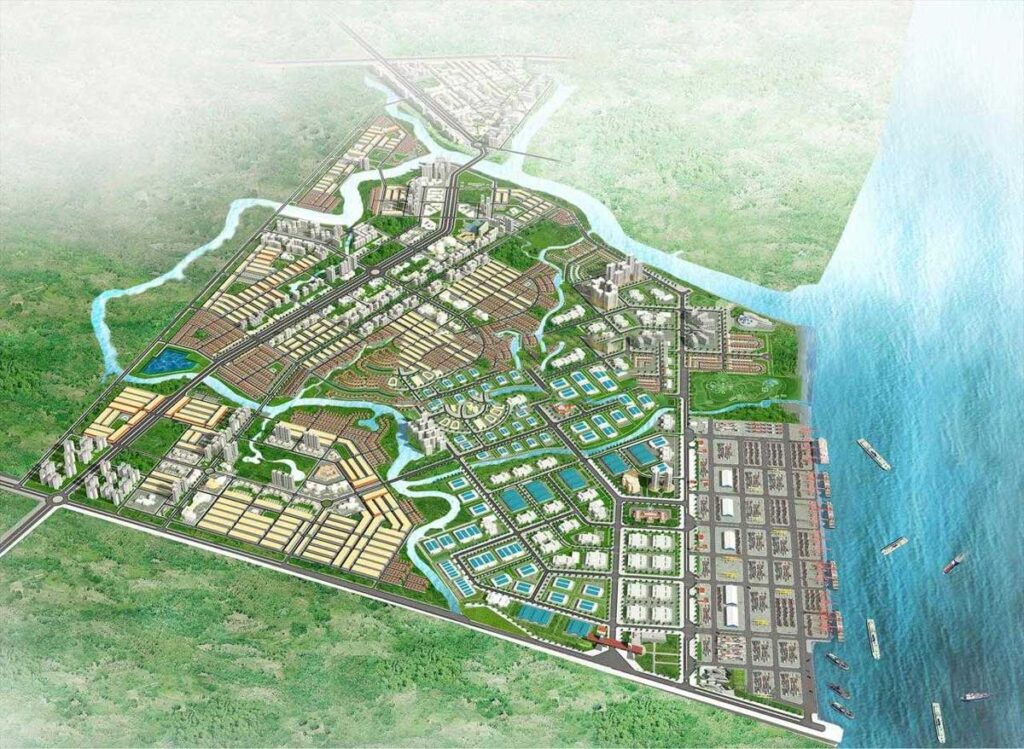
Perspective view of the Southeast Asia Industrial Park
Details
Industrial Park Name | Southeast Asia Industrial Park |
Location | Phuoc Vinh Dong commune and Tan Tap commune, Can Giuoc district, Long An province |
Total Area | 560 hectares |
Land Rental Price | 60 USD/m2 |
Construction Density | 60% |
Occupancy Rate | Updating |
Infrastructure Information
Electrical System | 22KV |
Water System | 2,400 m3/day |
Sewage System | The wastewater drainage system is constructed separately from the rainwater drainage system. Underground pipes of 300 and 400 mm diameter are laid along the sidewalks to collect wastewater, connecting to a 500 mm diameter pipe leading to a treatment plant for centralized processing. |
Traffic System | 110/22KV substation, capacity (2×63) MVA, Nam Tan Tap |
1. Project overview and legal information
The Southeast Asia Industrial Park (SEIP) is planned with a modern orientation, developing according to an integrated model of industrial and dynamic urban areas, creating a synchronized and convenient production and living environment.
Below is an overview of the Southeast Asia Industrial Park:
- Project Name: Southeast Asia Industrial Park
- Location: Phuoc Vinh Dong and Tan Tap communes, Can Giuoc district, Long An province
- Area: 396 hectares
- Operating period: 50 years (2016 – 2066)
- Occupancy rate: Updating
- Investment sectors: Knitting, garment manufacturing, yarn production; printing additives and packaging processing; household plastics; production of school supplies, children’s toys, sports equipment; production of plastic granules and PP packaging; product display and exhibition; production of cosmetic raw materials.
Amidst the increasingly evident trend of supply chain relocation from China to Vietnam, Long An is emerging as an attractive investment destination thanks to its proximity to Ho Chi Minh City, large land reserves, and diverse transportation infrastructure. The Southeast Asia Industrial Park is being developed to capitalize on this trend, with a well-planned layout aiming to become a model industrial park for the region, while providing a stable, safe, and sustainable production environment for businesses.

2. Investment costs and incentives
- Electricity Prices:
- Normal Hours: 1,669 VND/kWh
- Off-Peak Hours: 1,084 VND/kWh
- Peak Hours: 3,093 VND/kWh
- Telephone and Internet Costs: Applied according to the price list provided by VNPT Telecommunications Group.
Businesses operating in the Southeast Asia Industrial Park enjoy many attractive preferential policies and support, specifically as follows:
- Tax Incentives:
Businesses are exempt from income tax for the first two years from the date of profit generation, and receive a 50% reduction in tax payable for the following four years. - Support from the Investor:
- Personnel Recruitment Support:
Investors are supported in finding suitable labor sources, from management teams to technical engineers recruited in Ho Chi Minh City. Ho Chi Minh City and Long An Province have skilled workers trained at reputable vocational schools such as Viet Nhat Vocational College, Long An Technical Vocational College, and Long An Vocational College. In addition, a large workforce of general laborers from the local area and surrounding regions is readily available to meet production needs. - One-stop administrative procedures:
The entire process of applying for investment and operation permits is supported through a “one-stop, one-seal” mechanism, saving businesses time and costs, and providing free assistance with related procedures. - Free consultation:
The investor provides free consultation services in various fields such as environment, design and construction, completion certificates, legal ownership of the project, customs procedures, taxes, accounting, as well as assistance with bank loans for factory, machinery, and equipment investments. - Construction Material Incentives:
Businesses have access to construction materials at preferential prices from Dong Tam Group, including ready-mix concrete, centrifugal pipes, tiles, roofing tiles, paint, uPVC doors and windows, and sanitary ware. - Amenities and Services:
The industrial park provides all essential amenities such as electricity, water, and compressed natural gas (CNG) directly to factories at competitive prices. In addition, there are supporting services such as accommodation for workers and experts, a sports center, customs offices, bonded warehouses, banks, etc., helping businesses operate smoothly and efficiently.
- Personnel Recruitment Support:
3. Geographical location
The Southeast Asia Industrial Park boasts significant advantages in multimodal transportation connectivity, including road, waterway, and air routes, as it is located in Long An province – an area situated along the southwestern border of Ho Chi Minh City. This is considered a crucial gateway for trade, connecting the Southern key economic region with the Mekong Delta.
In particular, Can Giuoc district – where the project is located – is a dynamically developing area of Long An, being positioned to become the “industrial hub” of Ho Chi Minh City. Simultaneously, it serves as a strategic transit point between two major economic regions: the Southern key economic region (comprising Ho Chi Minh City, Dong Nai, Binh Duong, Ba Ria-Vung Tau, Binh Phuoc, Tay Ninh, Long An, and Tien Giang) and the Southwestern key economic region (comprising Can Tho, An Giang, Kien Giang, and Ca Mau).

Geographical location of Southeast Asia Industrial Park
Industrial Park Boundaries:
- North: Bordering Rach Vang River
- South: Bordering Provincial Road 830
- East: Bordering Soai Rap River and Long An Port Area
- West: Bordering Rach Heo Canal and planned urban area
Transportation Connections:
- Road: Convenient connection to major routes such as National Highway 1A, Ring Road 3, Ring Road 4, Ho Chi Minh City – Trung Luong – Can Tho Expressway and Provincial Road 830
- Air: Easy access to Tan Son Nhat International Airport and Long Thanh International Airport
Waterway: Quick connection to Bourbon Ben Luc Port, Long An International Port and Cat Lai Port

Long An International Port
Distance to key areas:
- Ho Chi Minh City Center: approximately 40 km
- Phu My Hung Urban Area (District 7): approximately 18 km
- Tan An City (Long An): approximately 50 km
- Hiep Phuoc Port: approximately 10 km
- Tan Son Nhat International Airport: approximately 65 km
4. Infrastructure System

The industrial park’s infrastructure is comprehensively invested in, effectively meeting the production and business needs of enterprises:
- Internal transportation:
The internal road system is paved with hot asphalt, built according to Vietnamese standard H30, with road widths ranging from 14m to 45m. The adjacent Provincial Road 830 has a road width of 24m, facilitating traffic and goods transportation. - Electricity system:
Electricity is supplied from the 110/22KV Nam Tan Tap transformer station, with a capacity of 2×63 MVA, ensuring stable power supply for the entire area. - Clean water supply system:
Water is sourced from the Saigon Water Supply Corporation. In the initial phase, water is supplied from the Bang Tam plant with a capacity of 2,400 m³/day. Dedicated pipeline systems (diameters from f100 to f600) are installed to each area, along with fire hydrants spaced 150–200m apart. - Wastewater treatment system:
The wastewater drainage system is designed separately from the rainwater drainage system. Wastewater is collected through underground pipes (300–400mm diameter) and led to a 500mm main pipeline for centralized treatment, ensuring compliance with QCVN 40:2011/BTNMT standards before discharge.

Infrastructure of Southeast Asia Industrial Park
- Solid Waste Management:
Ordinary household waste is collected by the local environmental unit. For industrial solid waste and hazardous waste, businesses will contract with specialized units for proper disposal in accordance with regulations. - Gas Supply Station:
The industrial park has a CNG/LPG natural gas supply station to serve production, with a minimum design capacity of approximately 6,000 m³/hour (equivalent to 0.717 kg/m³). - Fire Prevention and Fighting System:
Fire prevention and fighting forces in the industrial park and businesses are well-trained and regularly conduct drills to ensure readiness in case of incidents. - Telecommunications System:
Telecommunications infrastructure is connected from the regional station, with all cables laid underground, ensuring stable and secure communication. - Greenery and Landscape:
The industrial park is planned with a system of green spaces, parks, and green median strips along the main roads. The green space ratio is approximately 20% for the production area and 30% for the administrative and service area. - Other amenities:
The area also has a full range of supporting amenities such as a trade union headquarters, banks, police station, fire department, etc., contributing to creating a safe and convenient working environment for businesses.