
Vietnam's industry rises to a new level: From processing to mastering
The Vietnamese business community is growing stronger and stronger. The face of Vietnam’s industry is also changing dramatically: from “hired labor and assembly”, it has now begun to master technology and create products.
From employee to boss
“25 years ago, when many partners ordered components, we did not have them, but now I am very proud to be able to supply them at good prices and with guaranteed quality,” said Ms. Tran Thi Thu Trang, Chairwoman of the Board of Directors of Hanel PT.
Ms. Trang’s story reflects the journey of maturity of Vietnamese enterprises in the process of industrialization. However, according to her, the biggest challenge for Vietnam in the next decade is how to “shift from processing to manufacturing, from working for hire to mastering technology”.
In fact, the manufacturing industry accounts for about 25% of GDP, but most of it is still concentrated in the assembly stage, with low domestic value. The electronics group accounts for 33% of the country’s total export turnover, mostly undertaken by FDI corporations. According to the General Statistics Office (Ministry of Finance), in the period 2016-2024, exports of electronics, computers and components increased from 18.5 billion USD to 68 billion USD, while imports increased from 27.8 billion USD to more than 100 billion USD. The scale expanded rapidly, but the domestic value remained modest.
In the context of the 4.0 Industrial Revolution taking place strongly with core technologies such as artificial intelligence (AI), big data, cloud computing, robots, semiconductors, the competitive advantage between economies is being reshaped. Vietnam, a country in the stage of accelerating industrialization, has the opportunity to shorten the gap if it takes advantage of this opportunity.
According to Ms. Nguyen Thi Phuong Thao, Chairwoman of the Board of Directors of Sovico Group, the world is entering a period of “artificial intelligence” in all fields. “Vietnam has a golden opportunity to participate deeply in the global value chain, especially in fields such as semiconductors and AI. Vietnam’s time has come, if we dare to think, dare to do and go fast,” Ms. Thao said.
“We are living in an era where artificial intelligence, semiconductors, data and the digital economy are changing every day, every hour. These technologies not only shape the way we produce, but also change the way we live, learn and develop,” said Ms. Thao.
She cited that Vietnam is currently in the top 6 globally in terms of openness to artificial intelligence, and at the same time possesses a strongly developing innovation ecosystem, ranging from digital finance, smart manufacturing to clean energy.
In the semiconductor sector, the trend of shifting global supply chains gives Vietnam a special advantage: a safe, dynamic and attractive environment.
“For the first time, we have the opportunity to participate more deeply in the value chain of the world’s leading technology corporations,” Ms. Thao emphasized.
Progress from major government decisions
In recent years, the Party, the National Assembly and the Government have continuously issued landmark policies and guidelines to promote the in-depth development of Vietnam’s industry, shifting from “assembly” to “manufacturing” and “creation”.
Typical examples are Resolution 57-NQ/TW of the Politburo on breakthroughs in science and technology development, innovation and national digital transformation; Resolution 68-NQ/TW on developing the private economy into an important driving force of the economy; and Resolutions 193 and 198 of the National Assembly on developing high-tech industry.
On that basis, the Government has specified in Resolution 03/NQ-CP – Action Program to implement Resolution 57 – requiring ministries, branches and localities to review and remove institutional barriers, and at the same time issue specific mechanisms on investment and public procurement for new technology products. The Government also directed the development of a network of innovation and startup centers, promoting strategic areas such as semiconductors, artificial intelligence, digital technology, and smart cities.
By 2030, Vietnam aims to form at least 5 national key programs in the above fields, creating a foundation for the sustainable development of the high-tech industry.
The semiconductor sector is a typical example. Vietnam currently has more than 50 microchip design enterprises with about 7,000 engineers, along with 15 other enterprises participating in chip packaging and testing with more than 10,000 technicians. Viettel is expected to inaugurate its first chip factory – a turning point that will put Vietnam on the global chip manufacturing map.
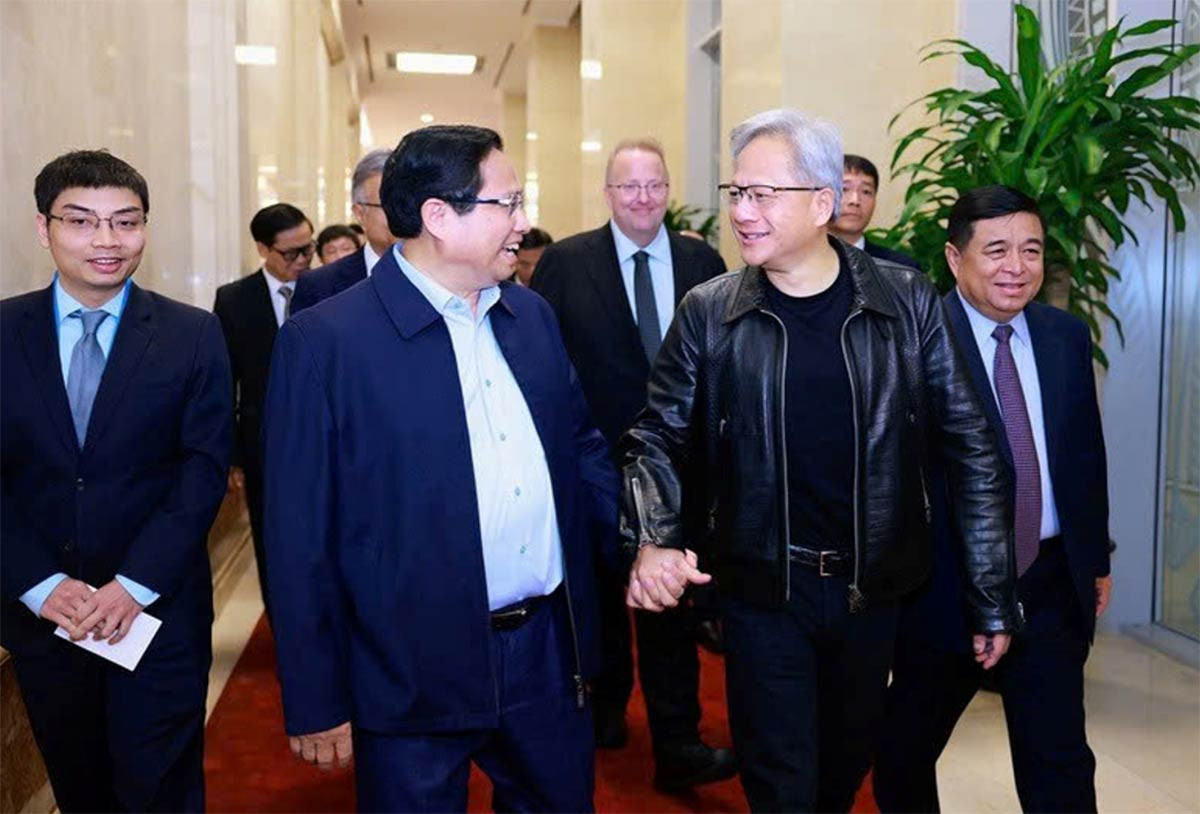
Notably, major technology corporations such as Nvidia, Qualcomm, Apple, Samsung, and Amkor have all chosen Vietnam as their production base or R&D center. Nvidia and Qualcomm’s choice of Vietnam as their strategic research center for AI and semiconductors shows that Vietnam’s position in the global value chain is changing rapidly.
At the same time, Vietnam has issued the Digital Technology Industry Law and is building a Key Industry Law, along with preferential policies on tax, land, infrastructure, and human resources to attract high-tech FDI flows. The government also encourages FDI enterprises to open R&D centers in Vietnam.
Looking to the future, according to the Ministry of Industry and Trade, Vietnam’s key industrial export products such as phones, computers, and machinery are currently mainly produced by the FDI sector. Large-scale Vietnamese enterprises are still few and face barriers in technical standards and trade promotion. Therefore, supporting enterprises to meet international standards is necessary for “Made by Vietnam” products to be qualified to penetrate demanding markets such as the US and EU.
The Ministry also believes that it is necessary to promote the transfer of advanced technology from abroad through a mechanism connecting Vietnamese enterprises with international partners, legal advice and financial support from the National Technology Innovation Fund or ODA sources for science and technology. Thanks to that, enterprises can easily access modern production lines, equipment and know-how at lower costs, contributing to accelerating industrial modernization and improving competitiveness.
According to the Ministry of Industry and Trade, smart industry is an opportunity for “shortened modernization”, helping Vietnam achieve modern industrial levels in a much shorter time than previous countries.
If the first countries to industrialize took hundreds of years like the UK, then countries like Japan shortened it to 50 years, and East Asian NICs like South Korea took less than 30 years, then the smart industrial revolution is an opportunity for Vietnam and other developing countries to shorten their industrialization time.
FPT Chairman Truong Gia Binh emphasized: “A country cannot be rich and powerful if it only works for hire and depends on foreign technology. We must be self-sufficient, creative, and create our own value.”
The path from “processing” to “mastering” is not easy, but Vietnam has a strategic vision, a strong enough policy foundation and political determination to take steady steps.
The Government’s efforts in perfecting institutions, improving the investment environment, developing technology human resources, attracting high-quality FDI and supporting innovative enterprises have opened a new chapter for Vietnam’s industry.
From being a “hired worker” for the world, Vietnam is moving closer to the goal of “mastering” the global value chain, gradually realizing the aspiration of becoming a modern, high-income industrial country by 2045.
Anh Duong
According to Vietnamnet Electronic Newspaper